Showing posts with label How to. Show all posts

Saturday, December 9, 2017

Homemade Chicken Broth


The best thing I've ever done to improve my cooking has been to make my own chicken broth. Making homemade chicken broth may sound intimidating, but it is probably the easiest thing in the world to make, it just takes a little block of time. This small investment each month has transformed my cooking from good to amazing. I get to pick all my fresh ingredients and I especially like that I can control the amount of salt added, which in this case, I add no salt to the broth. Opting to salt only after I use it in a dish. Not adding salt lends flexibility so I can reduce my broth to a demi-glace for that pop of intense flavor without it getting overly salty as it concentrates. If you were to do this with canned chicken broth, it would get too salty as it reduces. 

So next time you see whole chickens on sale, buy them and make your own chicken broth. When I'm ready to make broth, I buy two whole chickens and cut them up. I cut off the chicken legs, thighs and breasts and vacuum seal the meat and stick it in the freezer. What's left over...the rib cage, chicken necks and chicken wings gets tossed into the stock pot. This time, I also included a whole chicken leg and de-boned my thighs and put the thigh bones into the pot as well. Now we are ready to get started.

Homemade Chicken Broth

Makes about 16 cups

2 chicken carcasses, skin removed
filtered water
2 onions, chopped
2-3 carrots, chopped
2 celery stalks, chopped
2-3 bay leaves
1/2 bunch parsley stems
2 tsp. whole black peppercorns
8 sprigs of fresh thyme

Prepare your vegetables and set aside.
Remove the meat from your whole chicken and freeze for use later. Next remove the skin from the remaining carcass. It's ok to leave the skin on the wings. Fill up your stock pot with cold water so that it covers the chicken bones and bring it to a boil over high heat. Once it reaches a boil, immediately, turn the heat down to a very low simmer.
Once the water comes to a boil, the impurities will float to the top. Turn down the heat to low and skim with a spoon to remove the floating proteins and foam.
Add the onions, carrots and celery and heat at a very low simmer for 3-4 hours. Resist the urge to stir your stock. The key to clear chicken broth is that you don't stir or disturb the pot. Very low and very slow and no stirring. The water should never be boiling from this point on. The first boil was to remove impurities but now it sits and simmers for the next 3-4 hours.
After 3-4 hours of simmering, add your bouquet garni, which is parsley stems, thyme, bay leaves and black peppercorns and continue to simmer for one more hour. Make sure you only use the stems of parsley, if you use the leaves, the broth will take on a green color.
Turn off the heat and prepare to strain and freeze your homemade chicken broth. Get a clean stock pot and a chinois and place two layers of cheesecloth in it. If you don't have a strainer like this, use a collander layered with cheesecloth. Begin ladling hot broth into the strainer, allowing the clear broth to collect in the clean stock pot. Continue straining until all broth is collected and only bones and vegetables remain in your original stock pot.

To prevent spoilage, you'll need to cool your stock down quickly in order to place it in the freezer. I set up an ice bath with pre-labeled freezer bags, like this. (Normally I use a bigger ice bath but my other container was holding baked goods so I had to improvise, so give your self some room and use a bigger ice bath than this one. ;) 

Ladle 2 cups of hot broth into a measuring cup and then transfer broth into labeled freezer bags sitting in an ice bath. Zip up bag, taking care to remove as much air as possible. Let it sit in the ice bath until cooled a bit. Place sealed bag flat on a cookie sheet. Continue to cool and place bags of broth on cookie sheet making sure there are no leaks. I place a piece of parchment between the layers of bags so when they freeze they don't stick to each other. Place cookie sheet of bagged broth into the freezer until frozen. Once frozen, you can stack them in the freezer without the parchment paper or the cookie sheet. You're done. Now you have homemade chicken broth at the ready.
Other recipes to try:
How to make Dill Pickles


How to Roasted Peppers in the Oven

Saturday, April 27, 2013

Dill Pickles


I remember my Dad making pickled cucumbers was when I was a kid, maybe 9 years old. We had a garden in our backyard and we had a ton of cucumbers one summer and my Dad wanted to try to make pickles. I remember they were really limp and not crunchy at all. The flavor was there but they just didn't have the right texture. With that not so perfect pickle experience long behind me, I attempted to make my own pickles and have good news! Or as my 5 year old says when something good happens, "Lucky Day!" 

I stumbled on the best most perfect homemade pickle recipe out there. (courtesy of the blog At Home My Way via Pinterest) They taste just like Clausen Dill Pickles, crunchy and garlicky. The best part of this recipe is that there is no canning involved. You can put them in glass canning jars like I did but you don't have to. You can put them in a large plastic container with a lid. The cucumbers aren't heated so you won't get soggy limp cucumbers. In fact, they were so good, my kids ate the two big jars pictured above in two days. I keep the small jar of pickle slices way in the back of the fridge hidden so they can't get at them. :)  

Initially, what got me to try this recipe was that I got a really good deal on Persian cucumbers, 2 lbs for a dollar and a large bunch of fresh Dill also for a dollar. See aren't they beautiful? I knew my family couldn't eat this many before they went bad so when life gives you and abundance of cucumbers at a really great price, make pickles!
Dill Pickles (slightly adapted recipe from At Home my Way)

  • 2 pounds Persian cucumbers, (sliced, quartered or halved..I made all of these)
  • 1/3 cup dried minced onion
  • 6 cloves garlic, sliced
  • 1/2 T mustard seeds, (I used pickling spice)
  • 6 heads of fresh dill
  • 1 1/2 quart water
  • 2 cups cider vinegar (I used regular vinegar)
  • 1/2 cup canning salt (do not use regular salt, used canning salt)

In a large pot, add onion, garlic, mustard seeds (or pickling spice), dill heads, water, vinegar and canning salt. Bring to a boil to dissolve salt and let cool.
As pickling brine is cooling prep cucumbers. 

Starting with the right cucumber is the most important step. Use pickling cucumbers or thin skinned cucumbers like Persian or English. The waxy ones you get for salads are not good candidates for pickling. The skin is just too tough. 
Wash and slice cucumbers lengthwise into spears or halves or slices like so.

Place cucumbers in large canning jars or a deep plastic container with tight fitting lid. Add a few sprigs of fresh dill to the jars.


Once pickling brine is cooled, pour over cucumbers, making sure to add the pickling spices and garlic to each jar (I actually removed the wilted Dill at this point and added fresh dill to the cucumbers). Top off with brine and cover with lids. 

The recipe called for letting the pickles sit on the counter for three days and then refrigerate overnight. Turning the jars up-side-down a few times a day over the three days.
I actually put them right in the refrigerator and let them pickle in there for three days...and Ta Da!  Delicious!


I used these delicious pickles in my Mom's Macaroni Salad which is a regular dish for all our summer BBQ's. Keep a look out for the upcoming blog for her recipe. :)


Saturday, March 30, 2013

When Bananas Go Bad


Lately, my kids have lost their interest in eating bananas. They'll eat one and then leave the rest to ripen to extreme blackness, untouched. I personally only like bananas when they are just turning yellow and nearly still green. Anything riper than that and they're too sweet for me. So lately, I just don't buy them. But when I do and they end up looking like this...it's decision time.
I struggle whether to throw them away or make a batch of banana bread. Because let's face it, we never set out to make banana bread. We're forced into it as we witness the shadows overtake uneaten fruit sitting in full display on the kitchen counter. "It's a sad state when bananas go bad..." Reluctantly, since I don't like to waste food, I cave to the quiet torment of cast-off bananas and decide to make bread. Ugh! I don't like to be pressured into anything and especially not from rotting fruit. What if I'm in a hurry that day or worse what if it's summertime? There's no way I'm turning on the oven to bake some bread when it's 90 degrees out. No way Banana!

Here's a way to save the bananas without having to actually make banana bread until you're damn well ready. :) This is not a new idea, nor is it mine, but felt that it should be mentioned that bananas can be preserved with lemon juice and then frozen. Super easy! That way, when the weather gets cooler, or when you feel like making banana nut muffins for breakfast one morning, you'll be all set with super sweet ripe bananas.

Here's the easy step by step:

1.  Peel ripe bananas and place in a large measuring cup and mash until there are no lumps. (~4 bananas=1 1/2 cup)

Make your batches of preserved bananas into 1 1/2 cup servings or to the quantity needed in your banana bread/muffin recipe. Makes it easy to just thaw and dump it into your recipe with out having to measure.

2. Juice one lemon and add 1 1/2 Tbsp of lemon juice to the 1-1/2 cups of mashed bananas.
The lemon preserves the color of the bananas so they won't darken further while frozen.
In addition, if your banana bread recipe calls for using buttermilk, you can now just add regular milk in the recipe because the lemon present in the banana mixture adds the needed acid that is called out when you don't have buttermilk but can substitution with sour milk.
Here's the buttermilk substitution ratio for reference:
1 cup buttermilk-- substitute with 1 Tbsp lemon juice or vinegar plus enough milk to make up 1 cup.


3. Transfer the bananas into a freezer bag and label and date your bananas. Store in your freezer for up to six months. Thaw and use when ready. Easy-Breezy! :)

I'll be making some Oatmeal-Pecan Banana Muffins with some preserved bananas, so keep an eye out for them.

Wednesday, February 20, 2013

Oven Roasted Peppers


I bought two pounds of red, orange and yellow peppers for a dollar! Yes, one buck! I was so excited, I felt like I'd robbed the store. Do you know how expensive these colorful little guys are when you buy them individually? Well... there I was feeling like I got the deal of the century, and after two weeks of putting them in salads, making salsas, and adding them to sauces and stir frys, I still had a pound and a half left. Hmmm, not such a great deal if you don't use them. I wasn't sure I'd be able to force them on my family in another dish and was pretty certain that I'd end up throwing them away once they got all mushy in my vegetable crisper.  Yeah, news flash, at some point the crisper doesn't crisp any longer...sigh. Then it came to me...'why don't I roast and freeze them?'. They're so much better roasted anyway, right?
 
I thought roasting peppers was some complicated process, it had to be, because buying them at the grocery store is super expensive. Who knew it's one of the easiest things to do.  As I soon found out there's more than one way to skin a pepper. I read through various cookbooks and websites; some roast the peppers whole covered with olive oil others roast them on a grill or right on the stovetop burners and then cut up and seed the peppers afterward. All basically the same way, just in different order. I used the 'how to' from Allrecipes.com to roast my peppers.  I found it to be the most straight forward and I preferred doing all the preparation of the peppers before roasting them. So here we go...

Oven Roasted Peppers
1. Set oven to Broil on High.
2. Wash peppers.
3. Cut around the top of peppers with a knife. Kind of like a pumpkin, this allows you to pull out the stem along with the seeds together. Rinse. (see below...beautiful, they look like a flower.)

 
 4. Slice each pepper in half.
 5. Remove ribs and cut off the end portion of each pepper.
 6. Set aside end pieces to be used for salads, soups, sandwiches, etc.
 7. Use palm of hand or fingers to flatten peppers.
8. Arrange peppers, skin-side up on a parchment paper lined cookie sheet. Some 'how to's' call for coating the peppers with a little bit of olive oil, but there's no need to add oil or anything, they'll roast up beautifully just as is with no added fat.
 
 9. Broil on high for about 10-15 minutes, checking and rotating pan to ensure even roasting. Skins will start to turn black and you can add more time until you get the desired results. This took me about 15 minutes to get this amount of char. Remove from oven and cool completely. About 15 minutes.
 10. Once cooled, the charred skins will be easy to peel. Most of them come off as one large sheet.
 11. There now you have your beautifully roasted bell peppers. Ready to use or to freeze for later use.
 12. I opted to freeze mine to use later. Label your freezer bag and date it, ensure you have most air out of the bag and pop it into the freezer. Done.

And it's just that simple...Keep a look out for my next blog where I used these roasted peppers in my Crostini with Roasted Peppers, Goat cheese and Honey Appetizer. It's super delicious.

Saturday, February 16, 2013

Seasoning Cast Iron


A few weeks ago I found this beautiful enameled cast iron skillet on sale for thirty dollars, marked down from $90. I was so excited because I'd never had a cast iron skillet before and never cooked in one either. I was giddy thinking of all the possibilities: skillet corn bread, bacon, roasted potatoes, steaks...wow, what else can I cook in it? What are the rules? How do I clean it..Oh wait, before I can clean it, how do I season this pan to get it ready for use?

I went on a mission to educate myself on cast iron. First order of business, How to season this pan? The Internet was filled with all kinds of information on seasoning cast iron and after reading a few sites, they basically end up contradicting the next, each saying their way was best. Basically, you can use any type of oil to season your pan. Finally, I came across Sheryl Canter's website. She used a science-based approach to season cast iron where she considered the chemistry of oils and recommends using Flax Seed Oil for seasoning cast iron. She goes into her reasoning and the chemistry on her page. Now, this is a website I can sink my scientific teeth into. Many lifetimes ago I graduated from UCLA with a Biochemistry degree, so this type of information really spoke to my inner-nerd and sealed my decision to use Sheryl Canter's technique to season my cast iron skillet.

Her web page has tons of useful information and make sure to read the comments section, I read through all the comments and there was some really great information there too. Here is the link to her website. 
http://sherylcanter.com/wordpress/2010/01/a-science-based-technique-for-seasoning-cast-iron/

Seasoning Cast Iron
Here's a much simplified Chemistry lesson...In a nutshell, seasoning cast iron involves coating the pan with oil and heating the pan to very high temperatures (450-500+ degrees) in order to polymerize the fat. When fats/oils are super heated, a part of the fat molecule is cleaved off which creates a highly reactive molecule with an unpaired electron (free radical). The liberation of the free radical allows the fat molecules to change orientation and cross link (polymerize) with each other. The polymerization changes the properties of the oil from a clear, light yellow liquid into an extremely hard, slick, black substance. As we all have experienced when cleaning our ovens or BBQ grills, overheated or polymerized fat is no easy clean up job. That stuff is cemented on there. Not good for ovens but great for cast iron and that's the barrier we want, hard, slick and tough to remove. According to Sheryl Canter, Flax Oil will give you the hardest, slickest surface.

I picked up this bottle from The Vitamin Shoppe for about $11.
It's found in the refrigerated section because this oil goes rancid quickly. (Please do not confuse Flax Oil with Linseed Oil, Flax Oil is edible and available in Health food stores and Linseed Oil is not edible and found in Hardware stores. Both are derived from Flax Seeds.)

Now we are ready to season cast iron with Flax Oil.

Step 1: Make sure your pan is completely dry by placing the pan in a 200 degree oven for 10-15 minutes. Allow to cool enough to touch and proceed to Step 2.


Step 2: Add 1-2 Tbsp of Flax Seed Oil to pan. Rub in with hands to ensure complete coverage of cast iron surfaces.


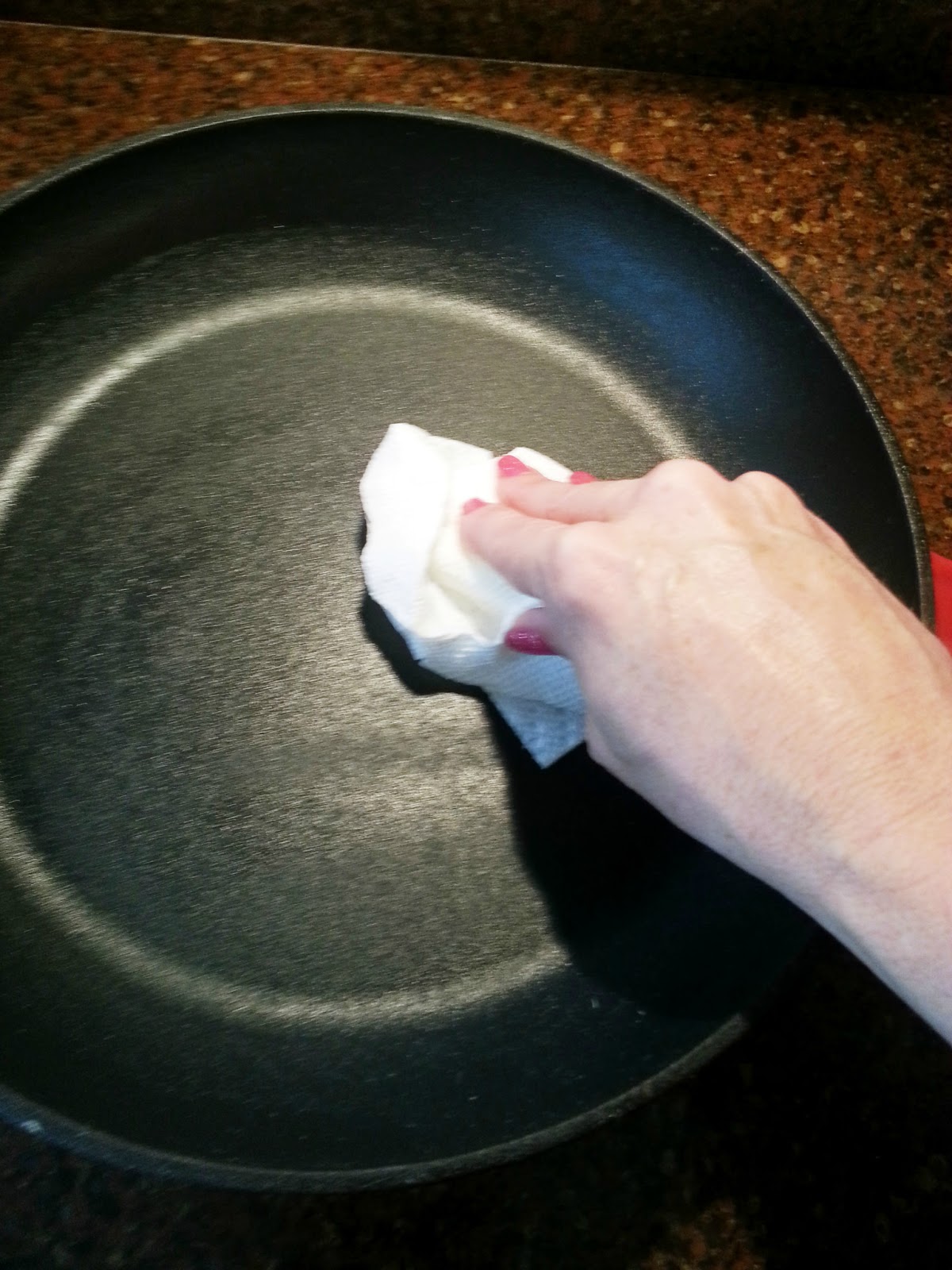
Step  3: Wipe off all excess oil with a paper towel until it's dry looking with no slick oily surface. The pan is still coated with a thin layer of flax oil but you don't want any excess oil to cause drips.
 

Step 4: Place pan upside down in a cold oven and turn temperature as high as your oven will go. I set mine to 520 degrees. My oven goes to 550 degrees but my smoke detectors go off at that range so I adjusted down. Allow oven to reach temperature and then heat pan for 1 hour at 520 degrees. After one hour, turn oven off and let the pan sit in oven for two hours.  Now the pan will be cool enough to touch. Remove pan and repeat steps 2-4. a minimum of 6 times. (Gasp??? What?) Yes, It took me a week and in fact I repeated this 7 times and look, my pan is absolutely stunning!


Cleaning Cast Iron
Next question about cast iron...How to clean it? I'd heard from numerous folks to never use soap, only hot water to clean a seasoned cast iron pan. That just didn't sound right to me because to cook with this baby, you have to use oil even with seasoning, this pan is not a Teflon pan so food will stick if you don't add oil. I imagined cooking bacon in it and not cleaning it with soap... won't everything else you cook in it have that faint bacon flavor. Okay so here's the deal. The seasoning is hard and will not come off with soap. Just think of your oven splatters, those don't come off easily with soap.
After I seasoned my pan, I cooked the most incredible roasted potatoes with bacon and Parmesan cheese in my new pan. I wanted to really test the surface and also test how to clean my new pan.
See my roasted potatoes, beautiful huh? They were divine!


Cleaning was a breeze. I wiped out the excess food with a paper towel. My pan's non-stick ability passed with flying colors since all that cheese and bacon came right off with no elbow grease. I added some liquid detergent to a cellulose sponge and cleaned it as I would any other pan and rinsed well with warm water. I dried it with a towel and then popped it into a 200 degree oven for 15 minutes to completely dry pan. I added about a teaspoon of olive oil and spread it all over the pan with a clean paper towel. Now the pan is clean and oiled ready for the next use. (Note: Do not use Flax Oil to coat your pan after cleaning. Flax oil is used for the seasoning process but shouldn't be used for cooking, two different things entirely) Also DO NOT soak your pan in water overnight, this will weaken the seasoning. Clean your pan right away and ensure it is completely dry by putting it in a warm oven before putting it away.


What can't I cook in a Seasoned Cast Iron Pan?

Seasoning protects the iron from rusting and provides some non-stick properties. The seasoning is hard and strong but it's not impervious to degradation. Certain foods will weaken the seasoning and cause it to flake off. Here are the rules:
It is not recommended to cook anything acidic in cast iron pans. Foods with vinegar in it, which includes marinades, so be vigilant and use another pan if you have a highly marinated meat. Tomato based ingredients, lemon and wine are also not recommended.
Also you don't want to braise anything in a seasoned cast iron pan. If you want to braise in cast iron, make sure it's a fully enameled cast iron dutch oven,not seasoned cast iron.

And that is it! Enjoy cooking in Cast Iron! Look out for my Roasted Potatoes with Bacon and Parmesan Cheese recipe. I'll post it next!